Views: 0 Author: Site Editor Publish Time: 2026-03-09 Origin: Site
Scrap metal management often looks simple from the outside, but the difference between an efficient recycling workflow and a costly waste problem usually depends on the equipment being used. A Metal Briquetting Machine plays a crucial role in transforming loose metal chips, turnings, and shavings into compact briquettes that are easier to store, transport, and reuse in melting processes. However, many buyers focus only on pressing force or machine price when evaluating equipment. In reality, the internal configuration and coordination of key components determine long-term performance, briquette density, operating stability, and fluid recovery efficiency. Understanding which parts matter most helps manufacturers and recyclers choose a machine that truly improves productivity and material recovery.
Machining operations generate large volumes of loose metal chips, especially from materials such as aluminum, copper, cast iron, and steel. These chips are difficult to handle in their raw form because they occupy excessive storage space, contain cutting fluids, and are inefficient for melting.
A metal briquetting machine compresses these loose materials under high pressure to form dense cylindrical or block-shaped briquettes. The process reduces the volume of scrap significantly while improving its value for recycling or remelting.
Dense briquettes offer several advantages:
Higher furnace charging efficiency
Reduced oxidation loss during melting
Easier handling and transport
Lower storage requirements
By converting scattered chips into uniform briquettes, recycling operations become more organized and profitable.
Although the briquetting principle is straightforward, the quality of briquettes and the stability of operation depend heavily on machine design. Poorly designed feeding systems can cause uneven input, weak hydraulic systems may result in inconsistent pressure, and unreliable control systems can interrupt production cycles.
Every component within the machine contributes to performance, including feeding equipment, compression chambers, hydraulic circuits, control systems, and discharge mechanisms. When these systems work together seamlessly, the machine can operate continuously while producing high-density briquettes with minimal energy waste.
Metal briquetting equipment typically appears after machining operations or metal chip collection stages. The typical workflow includes:
Collection of metal chips or turnings
Transport to briquetting equipment
Compression into briquettes
Storage or transport to smelting facilities
In modern recycling facilities, briquetting machines often operate alongside shredders, separators, or metal baling systems to maximize overall material recovery.
The feeding section is the entry point of the machine and plays an important role in ensuring stable operation. A well-designed hopper allows loose metal chips to flow consistently into the compression chamber without clogging or uneven accumulation.
An efficient hopper design typically includes:
Smooth interior surfaces for better material flow
Sufficient capacity for continuous operation
Reinforced structure for handling heavy scrap
Stable feeding prevents interruptions in the pressing cycle and helps maintain uniform briquette density.
In many industrial environments, metal chips are generated continuously during machining processes. To maintain consistent productivity, briquetting machines often integrate with conveyors or automated loading systems.
These systems transport scrap directly from production machines to the briquetting equipment. Automation reduces manual handling while ensuring the machine operates at optimal capacity.
Uneven feeding can lead to incomplete compression or irregular briquette shapes. When chips enter the chamber in consistent quantities, the compression cycle remains stable, producing briquettes with uniform density and structure.
This consistency improves both recycling value and furnace performance.
At the center of every briquetting machine lies the compression unit. The main hydraulic cylinder generates the pressure required to compact loose metal chips into dense briquettes.
The pressing force must be carefully calibrated according to the material being processed. For example:
Aluminum chips require moderate pressure
Copper or steel chips may require higher compression force
A robust hydraulic cylinder ensures that each pressing cycle delivers consistent force without fluctuations.
The compression chamber determines the final shape and density of the briquette. A well-engineered chamber allows chips to be compacted evenly while minimizing material loss.
High-quality chambers are typically constructed from wear-resistant steel to withstand repeated high-pressure operations.
The mold structure defines the final briquette form. Common shapes include cylindrical or square briquettes, depending on the application.
The geometry of the chamber influences how metal particles rearrange during compression. Proper chamber design ensures that chips interlock tightly, creating strong briquettes that maintain structural integrity during handling and transport.
The hydraulic system powers the entire compression process. It includes several key components:
Hydraulic pump
Control valves
Oil reservoir
Hydraulic pipelines
These components work together to deliver stable pressure throughout the pressing cycle.
Different metals respond differently to compression. Aluminum chips compress easily, while cast iron or steel require greater pressure.
Accurate pressure control ensures that each material type is compressed efficiently without overloading the machine.
A well-designed hydraulic system minimizes pressure fluctuations, reducing energy consumption and mechanical wear. Stable hydraulics also extend the service life of the machine while improving operational reliability.
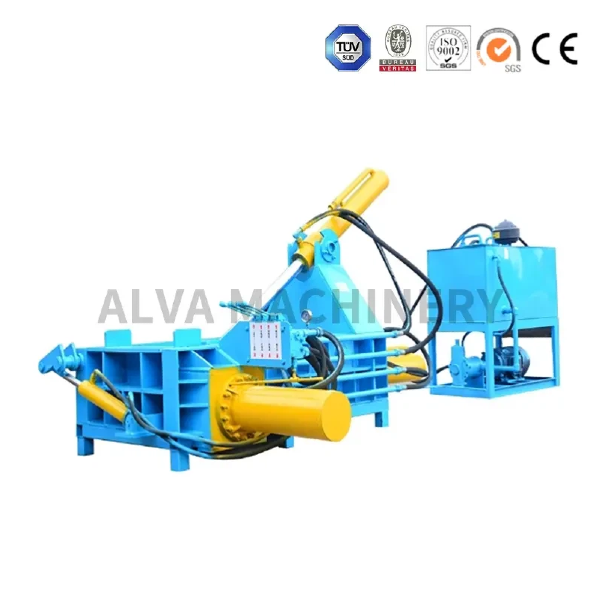
Modern briquetting machines rely on programmable logic controllers to manage the pressing cycle. PLC systems automate the sequence of feeding, compression, and discharge operations.
Automation allows operators to set parameters such as pressure, cycle time, and output rate.
Safety features are essential in industrial equipment. Sensors monitor machine status while interlock systems prevent unsafe operation.
Common safety mechanisms include:
Emergency stop systems
Door interlocks
Overload protection
These features ensure safe operation in demanding industrial environments.
Advanced control systems can detect abnormal conditions such as material blockage or hydraulic overload. When necessary, the system automatically pauses or reverses the operation to prevent damage.
This functionality helps maintain continuous production while protecting machine components.
After compression, the briquettes must be discharged efficiently from the chamber. The discharge system ensures smooth removal of finished briquettes without interrupting the production cycle.
Depending on plant configuration, briquettes may be transported via conveyors, collection bins, or automated storage systems.
Metal chips often contain cutting fluids used during machining operations. During compression, these fluids are squeezed out and collected separately.
Recovered fluids can be filtered and reused in production processes. This reduces operating costs and improves environmental performance.
Fluid recovery is particularly valuable in machining workshops where cutting oil represents a significant operating expense. Efficient recovery systems transform waste into reusable resources.
Some machine components experience more wear than others. Hydraulic seals, compression chamber surfaces, and certain mechanical parts require periodic inspection.
Machines designed with easy access points simplify maintenance procedures and reduce downtime.
Maintenance-friendly equipment includes features such as:
Accessible hydraulic components
Replaceable wear plates
Clear maintenance interfaces
These features help operators keep the machine running smoothly with minimal interruption.
Efficient maintenance reduces the likelihood of unexpected breakdowns. In industrial environments where production schedules are tight, reliable uptime is critical.
Compressed briquettes occupy far less space than loose metal chips. This reduction allows facilities to store larger quantities of scrap within the same area.
Transport efficiency also improves because briquettes are easier to handle and load.
Uniform briquettes melt more efficiently in furnaces compared with loose chips. Reduced surface area decreases oxidation loss during melting.
As a result, smelting operations achieve better metal recovery rates.
Pressing force alone does not determine machine performance. A truly effective briquetting system integrates feeding, compression, hydraulic stability, automation, and fluid recovery into a coordinated workflow.
Shandong Alva Machinery Co., Ltd. designs equipment with this integrated approach, ensuring stable operation and efficient resource utilization across diverse metal recycling environments.
Component | Main Function | Impact on Output | Maintenance Focus |
Feeding Hopper | Accepts loose metal chips | Ensures consistent material flow | Check for blockage |
Hydraulic Cylinder | Generates compression force | Determines briquette density | Inspect seals |
Compression Chamber | Shapes briquettes | Influences briquette structure | Wear plate inspection |
Hydraulic System | Controls pressure delivery | Maintains stable pressing cycle | Oil quality monitoring |
PLC Control System | Automates operation | Improves consistency | Electrical inspection |
Discharge Mechanism | Removes finished briquettes | Supports continuous production | Lubrication checks |
Understanding the internal structure of a briquetting system helps operators appreciate why some machines deliver better results than others. Feeding systems, compression chambers, hydraulic circuits, control technology, and discharge mechanisms must work together to ensure stable production and consistent briquette quality. Shandong Alva Machinery Co., Ltd. integrates these elements into reliable equipment designed to help industries recycle metal waste more efficiently and reduce operational costs. For companies seeking to improve scrap handling and metal recovery, investing in a high-performance metal briquetting system can transform loose machining waste into valuable recycled material.
If you would like to learn more about our equipment or explore suitable solutions for your recycling operation, please contact us. Our team will be glad to help you find the right equipment for your needs.
A metal briquetting machine can process aluminum chips, copper turnings, steel shavings, cast iron scraps, and other metal machining waste.
Briquettes are denser and more uniform, which improves furnace charging efficiency and reduces oxidation losses during melting.
Yes. During the compression process, cutting fluids are squeezed out of the metal chips and collected for potential reuse.
By compressing loose scrap into compact blocks, the machine reduces storage space, simplifies transportation, and increases the recycling value of metal waste.

 English