Views: 0 Author: Site Editor Publish Time: 2026-04-22 Origin: Site
Industrial metal recycling relies on extreme mechanical forces. Heavy-duty equipment turns bulky, hazardous scrap into uniform, furnace-ready commodities. The recycling sector demands highly efficient solutions to manage growing waste volumes. Beyond simple volume reduction, modern crushing systems play a highly technical role. They are precisely engineered to improve downstream smelting efficiency. They extract valuable non-ferrous metals. They also help facilities maintain strict environmental compliance.
For plant managers and recycling facility operators evaluating equipment, careful analysis is essential. You must understand the exact mechanical principles before making a major capital investment. Knowing material capabilities and Total Cost of Ownership (TCO) variables is critical before procuring a system. This comprehensive guide breaks down exactly how these machines operate. We will explore thermodynamic benefits, operational safety, and purchasing strategies to maximize your return on investment.
Mechanical Principles: Metal crushers utilize high-torque impact, pressure, or shearing forces to reduce scrap size and increase surface area for more efficient melting.
Process Stages: A complete system involves pre-treatment (defusing), primary crushing, and post-processing (magnetic/eddy current separation).
Operational ROI: Properly sized equipment lowers transportation costs, enables "Zorba" (mixed non-ferrous) extraction, and strips surface contaminants (delacquering) to maximize metal purity.
Purchasing Variables: Selecting the right machine requires balancing throughput capacity with drive type (electric vs. hydraulic), wear-part lifespan, and integrated safety controls.
At its core, a metal crusher machine uses massive kinetic and hydraulic energy to fracture rigid materials. Understanding the exact mechanical forces helps operators optimize their feed rates.
Industrial crushers rely on four primary physical mechanisms:
Press Rolling (Compression): Squeezing materials between two hard surfaces until they fracture.
Shearing (Cutting): Applying opposing forces to slice through ductile metals.
Impact (Striking): Using high-velocity collisions to shatter brittle, rigid scrap.
Grinding (Friction): Rubbing materials against abrasive surfaces to wear them down.
A successful metal recycling operation follows a strict three-stage workflow. Skipping a stage often causes catastrophic equipment failure.
Pre-Treatment (Defusing): Operators use pre-shredders to tear open baled materials. This vital step identifies uncrushable hazards. It prevents hidden gas cylinders or explosive items from detonating inside the primary chamber.
Primary Crushing & Sizing: Conveyors feed material into the main crushing chamber. Operators use batch or metered feeding techniques. Inside, heavy rotors, hammers, or jaws fracture the metal. The processing continues until the fragments pass through a standardized discharge screen.
Post-Processing & Separation: The system sorts the uniform output. Over-belt magnets quickly extract ferrous metals. Eddy current separators then repel non-ferrous metals into distinct bins. Finally, air classifiers use wind sifting to blow away light plastics and fluff.
Crushing provides massive thermodynamic advantages. We call this the "surface area principle." Smaller, uniform metal pieces pack closer together. This density drastically reduces internal air space. When scrap enters an electric arc furnace operating at roughly 3,000°F, heat transfer happens rapidly. You melt the scrap with significantly lower energy consumption. This efficiency protects the furnace lining and speeds up production cycles.
Many industry professionals use "crusher" and "shredder" interchangeably. However, they describe fundamentally different machines. Choosing the wrong mechanism damages the equipment and halts production.
Crushers: These machines rely heavily on immense pressure and blunt impact. They easily fracture rigid, dense materials. Common inputs include cast iron, heavy engine blocks, and raw ores. The resulting output looks irregular, jagged, and fractured.
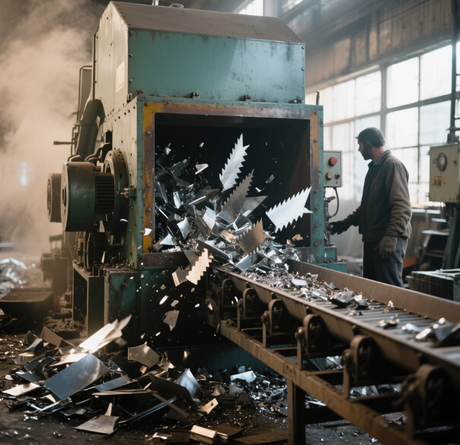
Shredders: These utilize low-speed, high-torque rotating blades. They shear, tear, and compress ductile or mixed waste. They excel at processing auto bodies, household appliances, and aluminum profiles. The output consists of uniform strips or chips.
Feature | Metal Crushers | Metal Shredders |
|---|---|---|
Primary Force | Pressure and blunt impact | Shearing and tearing |
Ideal Material Hardness | High (rigid, brittle, dense) | Low to Medium (ductile, mixed) |
Typical Inputs | Cast iron, engine blocks, ores | Auto bodies, appliances, wire |
Output Shape | Irregular, chunky fractures | Uniform strips, chips |
Certain reactive metals pose severe fire risks. Processing titanium or magnesium at high speeds generates intense friction. This friction creates sparks, leading to explosive deflagration. Shredders mitigate this risk by employing low-speed processing. Rotors turning at just 20 to 30 RPM prevent dangerous heat buildup. They shear the metal cleanly without igniting reactive dust.
Matching your scrap profile to the correct machinery determines your operational success. Several distinct architectures dominate the recycling industry.
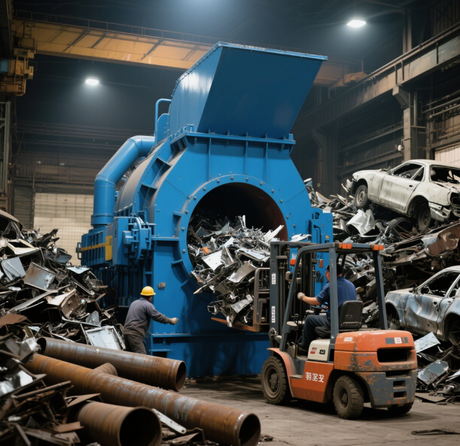
Hammer crushers use high-speed rotational forces. Mega-shredder variants feature heavy steel hammers. These hammers often weigh up to 1,000 lbs each. They spin rapidly, delivering devastating kinetic energy. This setup works best for high throughput demands. Operators rely on them to pulverize entire vehicle shells and large appliances.
Jaw crushers operate like a heavy-duty hinge. A stationary plate and a moving plate form a V-shaped chamber. The moving jaw continuously crushes bulky, rigid items against the stationary plate. They are ideal for primary volume reduction. Use them to break down extremely hard, oversized industrial castings.
Cone crushers compress metal between a stationary outer mantle and a rotating inner cone. The gap narrows as material falls deeper into the chamber. This squeezing action refines the scrap. They are exceptionally well-suited for medium-hard steel and iron refinement.
Shaft-based machines offer incredible versatility. They handle varying degrees of material complexity.
Single-shaft: These provide high torque. They perform well when processing uniform light metals.
Dual-shaft: These machines introduce counter-rotating shear forces. They effortlessly chew through mixed industrial scrap.
Quad-shaft: These integrate precise cutting and sizing screens. They tackle complex waste streams. Electronic waste (e-waste) requires precise particle sizes to separate gold and copper effectively.
Equipment Category | Primary Mechanism | Best Suited For | Throughput Capacity |
|---|---|---|---|
Hammer Crusher | High-speed Impact | Vehicle shells, large appliances | Very High (up to 400+ tons/hr) |
Jaw Crusher | Heavy Compression | Oversized rigid industrial castings | High (Primary stage only) |
Cone Crusher | Squeezing / Grinding | Medium-hard steel and iron refinement | Medium to High |
Quad-shaft System | Shearing with Screens | E-waste, complex mixed materials | Medium (High precision) |
Facility owners often view crushing equipment solely as an expense. However, proper processing completely transforms the facility's profit margins. Volume reduction and material purity directly influence your Total Cost of Ownership (TCO).
Transporting loose, bulky scrap wastes money. You end up paying to ship empty air. A powerful crusher drastically increases material density. Volume reduction means you can pack maximum tonnage into every shipping container. This single benefit drastically lowers logistical freight costs per ton.
Crushing acts as a harsh, mechanical "delacquering" phase. The intense friction strips away surface paints, rust, and chemical coatings. Removing these contaminants improves the quality of the final melt. Smelters pay premium prices for clean, uniform, densely packed materials.
Modern recycling relies on "Zorba" recovery. Zorba is the industry term for mixed non-ferrous fragments. Shredded automobiles yield large amounts of Zorba. You extract these valuable fragments using eddy current separators. Often, the revenue generated from selling Zorba entirely offsets the operational expenditures (OPEX) of the crushing plant.
The macro-level energy savings define the industry's environmental value. Melting recycled metal requires far less energy than extracting virgin ore. Aluminum recycling delivers a massive 95% energy savings. Steel recycling saves about 60% of energy. These verified benchmarks strongly support facility ESG (Environmental, Social, and Governance) targets.
Common Mistakes to Avoid in ROI Calculation
Ignoring wear-part replacement costs in annual OPEX projections.
Failing to account for the premium value of clean Zorba.
Underestimating the savings gained from reduced freight trips.
Before you evaluate any metal crusher machine for sale, you must assess your specific facility requirements. A poorly chosen machine causes endless downtime and severe safety hazards.
Never buy an undersized machine to save upfront capital. Running a unit at 100% maximum capacity accelerates mechanical wear. Components fatigue quickly, and breakdowns multiply. We highly recommend selecting a machine with a 20% to 30% capacity buffer. This buffer ensures longevity and handles unexpected processing surges smoothly.
The drive system dictates how the machine reacts to stress.
Hydraulic Systems: These offer superior resistance to massive shock loads. When unpredictable materials jam the rotors, hydraulic systems absorb the impact safely. They perform best for heavy, unpredictable scrap processing.
Electric Systems: These units typically maintain a smaller footprint. They offer lower carbon emissions and run quieter. Furthermore, electric drives integrate much easier into fully automated processing lines.
Safety features directly impact machine uptime. Advanced systems include auto-reverse anti-jamming software. When resistance peaks, the software momentarily reverses the rotors to clear the blockage. Additionally, look for UV and infrared spark detection systems. They instantly deploy suppressants to prevent catastrophic fires. Always ensure the equipment design supports strict lock-out/tag-out (LOTO) maintenance accessibility.
Industrial regulations demand strict emissions management. Look for fully enclosed crushing systems. They must feature robust air pollution controls. Quality systems integrate cyclone separators and high-capacity baghouses. These components capture volatile organic compounds (VOCs) and highly toxic dust, such as hexavalent chromium. Meeting these compliance controls prevents costly regulatory fines.
Best Practices for Equipment Evaluation
Conduct spatial analysis to ensure adequate clearance for maintenance access.
Request material testing using your own typical scrap profile.
Verify the availability of local service technicians and spare parts.
A metal crusher operates as far more than just a demolition tool. It is a highly engineered precision sizing and separation asset. The capabilities of your primary crushing modules dictate the profitability of your entire recycling lifecycle. Investing in the right technology ensures maximum material recovery while drastically reducing downstream energy consumption.
Before requesting vendor quotes, buyers must take strategic action. You must audit your inbound material streams carefully. Assess the exact ratio of ferrous to non-ferrous metals. Note the balance between rigid and ductile scrap. Consult with experienced structural engineers to conduct a full facility spatial analysis. Thorough preparation guarantees you deploy a specialized pre-shredding and primary crushing system that delivers true operational excellence.
A: Modern industrial crushers feature automated overload protection systems. If a massive, uncrushable object enters the chamber, sensors detect the sudden spike in hydraulic or electrical resistance. The machine instantly halts. It then engages an auto-reverse function to dislodge the material, preventing catastrophic rotor damage or shaft snapping.
A: Lifespan depends entirely on material hardness and processing volume. Heavy continuous use degrades wear parts rapidly. Operators must perform routine hard-facing and welding maintenance weekly to extend part life. Without proper maintenance, hammers processing hard steel may require complete replacement every few months.
A: Yes, water plays a crucial role in dust suppression and temperature control. Facilities use dry systems with air extraction, wet systems that heavily wash the material, or semi-wet systems. Semi-wet systems use ultra-fine misting sprays to control combustible dust without creating massive wastewater runoff issues.
A: Footprints vary drastically based on modularity. A compact quad-shaft system designed for e-waste might occupy a single room. Conversely, a multi-acre mega-shredder installation processing vehicle shells requires massive conveyors, staging yards, and massive downstream separation modules, spanning several acres.