Views: 0 Author: Site Editor Publish Time: 2026-04-12 Origin: Site
Establishing metal recycling scalability brings incredibly high stakes. Choosing the wrong crusher size creates a massive sunk capital expenditure. Alternatively, it becomes an operational bottleneck. This bottleneck bleeds your margin through excessive manual labor and constant downtime.
Facilities often transition from low-volume sorting to continuous-feed processing. When this happens, operational demands shift drastically. You move away from basic volume reduction. Instead, you must focus on precision output. Modern smelters demand size uniformity and high-purity separation. You need these qualities to stay competitive.
Navigating the upgrade from a small-scale unit to an industrial metal crusher requires careful analysis. You must move beyond simple upfront price tags. We recommend evaluating your Total Cost of Ownership (TCO). You must also consider material-specific throughput and your current infrastructure readiness. This guide will show you exactly how to make the right equipment choice.
Throughput vs. Flexibility: Industrial crushers excel in continuous, heavy-load environments (10–50+ tons/hour), whereas small-scale units offer operational agility for batch processing and localized, low-volume yards.
The TCO Flip Point: While small crushers have attractive initial price points, industrial systems offset their massive CapEx through lower per-ton operational costs, reduced manual labor, and automated separation.
Infrastructure Realities: Upgrading is not plug-and-play. Heavy-duty equipment demands specialized high-voltage power grids, reinforced foundations, and dedicated predictive maintenance protocols.
Material Specificity: Processing heavy, dense materials (H-beams, engine blocks) mandates high-torque industrial machinery; utilizing undersized equipment for these tasks guarantees rapid wear-part failure and catastrophic downtime.
Understanding equipment baselines prevents costly procurement errors. We must define the core mechanics before comparing operational metrics. Small units and heavy-duty systems serve entirely distinct business models.
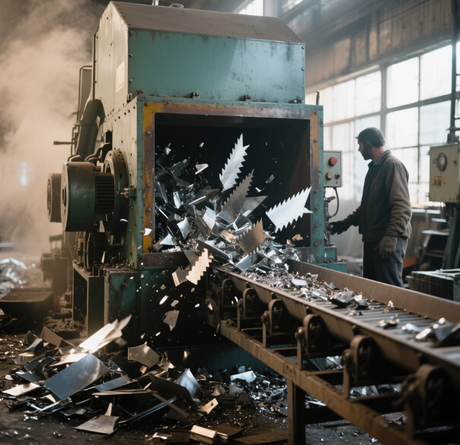
Small-scale crushers prioritize flexibility over sheer power. Their engineering suits localized scrap yards. They handle light manufacturing waste effectively. You will also see them used for niche separation tasks. Examples include stripping copper wire or crushing thin aluminum extrusions.
Their footprint remains highly compact. Manufacturers often build them on skid mounts. You can move them across a facility without heavy cranes. They require almost minimal foundation preparation. A standard concrete floor usually suffices.
Power dynamics favor simplicity. These machines operate on standard industrial electrical setups. They offer plug-and-play readiness. The overall kilowatt draw remains low. This keeps electrical infrastructure costs manageable for small operators.
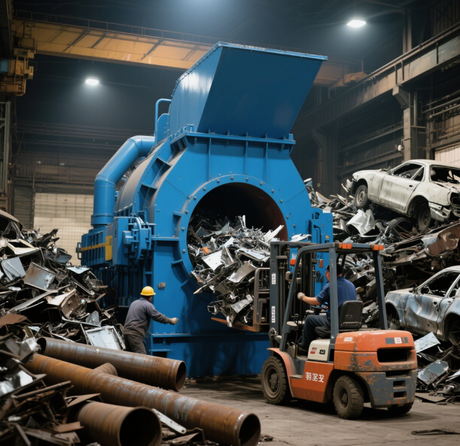
Heavy-duty systems target absolute volume. Engineers build them for heavy solid metal. They consume end-of-life vehicles (ELVs) effortlessly. Large-scale municipal and industrial scrap operations rely on them daily. Their design intent focuses on relentless, continuous operation.
The footprint presents a massive structural challenge. These systems require heavily reinforced concrete foundations. You will need a heavy crane for installation. Dedicated facility zoning becomes mandatory. You cannot simply drop them onto an existing warehouse floor.
Power demands are extreme. They draw hundreds of kilowatts, typically ranging from 150 to over 400 kW. This scale demands high-efficiency IE4 motors. Operators must use sophisticated PLC controllers. Rigorous power grid evaluations are non-negotiable before purchase.
Raw capacity tells only half the story. The true value lies in processing efficiency and output quality. Let us examine how these two machine classes handle material.
Small units rely on intermittent, manual feeding. Workers must pace the material flow carefully. This batch processing limits daily tonnage. In contrast, heavy-duty systems use automated, continuous-feed capabilities. Conveyors supply material without interruption.
Operators frequently risk "choke feeding" undersized machines. Dumping too much scrap jams the rotors. This causes immediate shutdowns. Heavy-duty systems prevent this through optimal load balancing. Sensors detect rotor strain. They automatically reverse or slow the feed conveyor to prevent jams.
Output geometry directly impacts market value. Heavy-duty hammer mills and vertical impact crushers excel here. They yield highly uniform, cube-shaped particles. Smelters prefer these dense cubes. They melt faster and more evenly.
Poor output quality carries a heavy financial penalty. Small manual operations often produce irregular, jagged fragments. These fragments trap contaminants. Downstream buyers notice this instantly. They will downgrade premium aluminum prices if they detect steel contamination hidden inside folded metal sheets.
Purification happens inline with heavy-duty models. They natively integrate with magnetic separators. They utilize eddy current systems. These additions provide immediate, automated purification. Clean metal drops directly into shipping containers.
Small units lack these native integrations. Operators often require secondary, manual sorting steps. Workers must sift through piles to remove tramp iron. This adds significant labor costs. It also introduces human error into your quality control process.
Feature | Small-Scale Crushers | Heavy-Duty Industrial Systems |
|---|---|---|
Feed Style | Manual, intermittent batch processing | Automated, continuous conveyor feed |
Throughput | 1 to 5 tons per hour | 10 to 50+ tons per hour |
Particle Output | Irregular fragments, variable sizes | Uniform, dense, cube-shaped pieces |
Sorting Integration | Manual sorting usually required | Integrated magnetic & eddy current systems |
Feeding the wrong scrap into your machine guarantees failure. You must align your inbound material types with appropriate mechanical capabilities.
Small-scale units have a distinct sweet spot. They excel at processing radiators and household appliances. They easily handle thin metal gauges and electronic waste. In these scenarios, precision shearing or granulating proves more critical than brute force.
Industrial systems target an entirely different sweet spot. They dominate heavy gauge steel and car shells. They process thick industrial manufacturing offcuts easily. Dense multi-metal alloys pose no challenge to their massive rotors.
Common Mistake: Do not buy a machine based purely on peak tonnage claims. Always verify the maximum material hardness rating. High tonnage means nothing if the machine cannot crack the density of your specific scrap.
Mechanical consequences hit hard when you mismatch equipment. Feeding heavy solid scrap into a light-duty machine is disastrous. You overstress the entire drivetrain immediately. Forcing a small machine to act as a heavy metal metal crusher leads to immediate motor overload. You will snap drive shafts. You will ruin expensive blade sets within hours.
This undersizing approach seems cheaper initially. However, repair bills quickly consume any perceived savings. You also face catastrophic downtime while waiting for replacement shafts.
Blade degradation impacts your bottom line heavily. Basic steel blades in small units degrade quickly. You face replacement cycles around every 2,000 hours. You must schedule frequent maintenance windows.
Heavy-duty environments demand superior metallurgy. Industrial systems utilize advanced high-temperature ceramic composite hammers. These components boast an 8,000+ hour lifespan. They resist extreme impacts and abrasion. This extended lifespan slashes your annual consumable budget drastically.
Smart procurement requires looking beyond the sticker price. Total Cost of Ownership (TCO) dictates long-term profitability. You must analyze both fixed and variable expenses.
We must frame this as a Bottom of Funnel (BoFU) evaluation. Small systems require low initial capital. This makes them highly attractive to startups. However, they suffer from high variable costs. They rely heavily on manual labor. They require frequent maintenance. They often produce lower-value output.
Heavy-duty equipment requires major capital. Investments often reach millions of dollars. Yet, they achieve a vastly superior Return on Investment (ROI). They use volume dilution to their advantage. Processing 50 tons an hour reduces your operational cost to mere pennies per ton.
We call unplanned outages the "Cost of Silence." Every hour a large machine sits idle costs thousands of dollars. You lose production. You still pay wages. You miss shipping deadlines.
Therefore, advanced units utilize IoT predictive maintenance. They monitor vibration and temperature sensors continuously. Algorithms predict bearing failures weeks before they happen. You fix issues during scheduled shifts.
Small-scale maintenance looks very different. It relies on reactive, manual tool repairs. A worker hears a grinding noise and shuts the system down. These incidents cost less per event. However, they occur much more frequently under high strain.
Energy consumption per ton defines processing profitability. Heavy-duty systems use significantly more total power. A 400kW motor spins massive amounts of steel. However, they process materials exponentially faster.
This speed creates better overall energy economics. Crushing ten tons in twenty minutes uses less energy per ton than crushing it over five hours. High-volume processors maximize this energy efficiency daily.
Best Practice: Ask manufacturers for a verified "kWh per ton processed" metric based on your specific material. Use this figure to project your annual utility costs before signing a purchase order.
Choosing the right equipment requires a systematic approach. Follow this structured framework to evaluate your facility's needs objectively. Eliminate guesswork from your procurement strategy.
Audit Material Volume and Hardness: You must define your peak daily tonnage accurately. Do not use average volumes. Calculate your absolute maximum load. Next, determine the maximum hardness and thickness of your inbound scrap. This dictates the minimum torque requirements for your new machine.
Assess Facility Constraints: Conduct a rigorous physical site audit. Measure available floor space carefully. Check your foundation weight limits with a structural engineer. Most importantly, verify your electrical grid capacity. Do not shortlist heavy-duty models if your facility cannot support a massive 400kW power draw.
Map Downstream Sales Requirements: Talk to your smelter partners. Ask them how they penalize cross-contamination. Determine if they require strict particle homogeneity. If buyers demand high purity, prioritize models with integrated inline sorting capabilities.
Request Real-World Material Testing: Never buy heavy machinery based purely on glossy spec sheets. Demand real-world proof. Make the manufacturer run a test batch using your specific scrap. You must verify their throughput claims visually. You should also inspect wear-part degradation after the test run.
The choice between small-scale and heavy-duty crushing rarely comes down to raw price. It focuses entirely on aligning processing capabilities with market demands. Upgrading equipment transforms your business model from manual volume reduction to automated, high-margin commodity production.
Operations processing less than a few tons a day should stick to smaller units. They handle uniform, light materials perfectly. They leverage agility to maintain steady cash flow. They keep infrastructure requirements comfortably low.
However, ambitious facilities must think bigger. If you aim to scale throughput massively, you must eliminate manual handling. To tackle heavy solid metals safely, you must accept higher capital expenditures. Investing in heavy-duty architecture is the only way to remain competitive and profitable in a high-volume recycling market.
Conduct a one-week audit of your current downtime and labor costs related to material sorting.
Consult a structural engineer to evaluate your concrete foundation's dynamic load capacity.
Ship a one-ton sample of your toughest scrap to a manufacturer for a live performance test.
A: Heavy-duty crushers last decades when maintained properly. Their wear parts, like ceramic composite hammers, offer 8,000+ hours of continuous use. Small-scale units typically require complete blade replacements every 2,000 hours. Continuous heavy-load systems use superior metallurgy to withstand extreme impacts, whereas batch-oriented machines wear out rapidly if pushed beyond light-duty tasks.
A: The economic tipping point usually occurs around 10 to 15 tons per day. At this volume, the costs of manual feeding, reactive maintenance, and labor outpace heavy equipment depreciation. Once your daily tonnage causes constant bottlenecks and manual sorting limits your output purity, upgrading becomes financially mandatory.
A: Yes, they are highly capable of processing light metals. However, it is rarely energy-efficient. Using a massive 400kW machine to shred highly ductile, thin aluminum wire wastes electrical power. For thin gauges and complex e-waste, dedicated small-scale shredders or granulators achieve better precision and energy economics.