Views: 0 Author: Site Editor Publish Time: 2026-09-27 Origin: Site
Modern recycling facilities face a brutal operational reality. Extracting valuable non-ferrous metals from chaotic mixed scrap streams like auto shredder residue, electronic waste, and municipal solid waste is no longer just about basic sorting. Smelters and refineries now enforce ruthlessly strict purity standards. They will heavily penalize or outright reject loads containing high plastic or ferrous contaminants.
Looking at recent industry shifts, the global push toward a circular economy has skyrocketed the demand for high-grade secondary metals. Relying on outdated manual sorting or dense media separation is a fast track to shrinking profit margins. To survive and remain competitive, plants are upgrading to advanced electromagnetic sorting lines. However, buying the equipment is only step one. Countless plant managers bleed profit daily because they ignore two critical, floor-level variables: feed size and belt speed.
This engineering guide breaks down the actual physics and daily floor applications of magnetic separation. By mastering the mechanical relationship between scrap dimensions and belt velocity, operators can tune their setup to hit peak purity grades, slash cross-contamination, and stop sending lucrative commodities to the landfill.
Physical Dimensions Dictate Force: The surface area of a scrap particle directly controls the strength of the induced magnetic currents. Uniformly sized material batches always yield the cleanest separation.
Velocity Controls Trajectory: The conveyor belt speed determines exactly how materials launch off the magnetic rotor. Pushing the speed too high causes unpredictable bouncing, while running too slow bottlenecks your entire plant throughput.
Mechanical Synergy is Mandatory: High recovery demands a mathematical balance between feed size and belt speed. Tweaking one parameter in isolation will instantly throw off the other.
Upstream Prep is Non-Negotiable: Shredding, screening, and sizing mixed scrap before it ever touches the magnetic zone is a strict prerequisite for high-efficiency grading.
Hardware Customization: Specifying equipment with variable frequency drives and eccentric rotor configurations allows plants to target specific metals based on their unique physical densities.
At its core, electromagnetic sorting relies on Faraday’s Law of Induction. The machinery features a high-speed magnetic rotor positioned inside a non-metallic rotating outer drum. This assembly sits right at the discharge head of a conveyor belt. As the internal rotor spins at extreme velocities—often exceeding 3,000 revolutions per minute—it generates a rapidly alternating magnetic field. When conductive metals travel through this dynamic zone, electrical currents form instantly within the metal particles.
Specifically, these newly formed currents create a secondary magnetic field that violently opposes the primary field of the spinning rotor. This magnetic clash produces a sudden, tangible repulsive force. Stand on the sorting floor, and you can literally see the metal jump forward, altering its airborne flight path. In contrast, inert materials like plastics, glass, and wood remain completely dead to the magnetic turbulence. They simply drop off the edge of the belt under the natural pull of gravity.
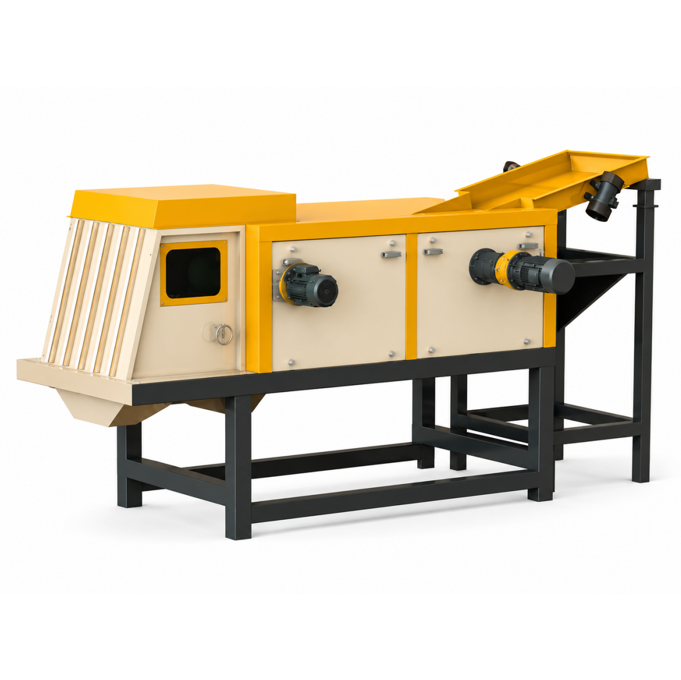
Mixed scrap streams are chaotic matrices of heavy polymers, ceramics, and high-value metals. Extracting the conductive fraction efficiently requires a heavy-duty non-ferrous metal separator. Automating this extraction process allows modern plants to process massive tonnages continuously, which translates directly to expanded profit margins and a reduced environmental footprint.
One of the most frequently mismanaged variables on the sorting floor is the dimensional footprint of the input material. The repulsion force generated by the magnetic rotor relies heavily on the physical volume and surface area of the individual scrap piece. A larger surface area acts like a broad canvas. It allows expansive, robust currents to form. Consequently, a massive chunk of cast aluminum will experience an overwhelming push, resulting in a dramatic leap over the mechanical splitter plate.
Fine particles measuring under 5 millimeters present a formidable mechanical challenge. Their limited mass and minuscule surface area prevent the induction of strong currents. Standard rotors simply cannot generate a field change rapid enough to repel these fines effectively. Capturing micro-metals requires specialized high-frequency rotors engineered with a denser concentration of magnetic poles.
A catastrophic operational error is feeding the system with a wildly inconsistent size distribution. Imagine dumping 100-millimeter heavy automotive parts onto the belt alongside tiny shredded copper wires. The mechanical physics instantly break down. If you set the splitter plate to catch the heavy, distant throw of the large parts, the smaller wires will fall short and end up in the waste bin. Furthermore, large chunks can physically collide with smaller repelled metals mid-air, knocking valuable material downward into the residual stream.
To fix size-related inefficiencies, you must implement rigorous upstream preparation. Empirical data from the field consistently proves that narrowing the size fraction of the feed material drastically elevates recovery rates. Best practices dictate integrating industrial shredders followed by multi-deck vibrating screens. Categorizing scrap into strict, narrow fractions before it reaches the magnetic zone allows operators to calibrate the machine specifically for the aerodynamic profile of that exact size class.
Feed Size Category | Typical Scrap Type | Required Rotor Design | Optimal Belt Speed |
|---|---|---|---|
Large (50mm - 150mm) | Auto parts, heavy extrusions | Standard Concentric / Eccentric | 1.0 - 1.5 meters/second |
Medium (10mm - 50mm) | General mixed recyclables | Eccentric Rotor | 1.5 - 2.0 meters/second |
Fine (2mm - 10mm) | Electronic shred, wire chops | High-Frequency (3000+ RPM) | 2.0 - 2.5 meters/second |
If the magnetic rotor serves as the engine of the operation, the conveyor belt acts as the steering wheel. The linear velocity of the belt dictates the initial horizontal speed of the scrap as it enters the magnetic field. As materials discharge from the head pulley, they follow a parabolic trajectory governed by gravity, their initial forward velocity, and the magnetic push.
The mechanical splitter plate is the physical barrier dividing your product streams. It must be meticulously positioned to intersect the exact gap between the falling inert waste and the repulsed metals. Should an operator arbitrarily change the belt speed, the entire trajectory curve shifts instantly. Without an immediate recalibration of the splitter's angle and distance, severe product contamination is inevitable.
Facility managers constantly navigate the inherent trade-off between throughput volume and sorting precision when adjusting their recycling sorting equipment. Faster belts maximize ton-per-hour processing capacity. However, extreme speeds introduce kinetic instability. Lightweight materials may bounce or roll, altering their position right at the critical moment of magnetic exposure. A faster belt also reduces the magnetic dwell time, which severely weakens the repulsion force.
Slower belts ensure maximum magnetic influence time. This yields highly accurate, predictable trajectories. The primary drawback here is a drastic reduction in volumetric processing, which can easily create bottlenecks across the entire plant.
Regardless of the selected velocity, the belt must move fast enough to guarantee that incoming material is spread into a strict single layer, commonly referred to as a monolayer. Operators staring at stacked piles of scrap on a moving belt are watching money go to the landfill. When heavy inert materials rest on top of metals, they physically pin them down. The magnetic force is rarely strong enough to blast a piece of aluminum through three inches of wet rubber, causing the trapped metal to drop directly into the waste chute.
Due to its unique physical properties, aluminum is widely considered the easiest metal to capture. It boasts excellent electrical conductivity combined with a remarkably low physical density. This high conductivity-to-density ratio means that the induced magnetic currents effortlessly overpower the metal's gravitational weight.
When tuning the system to function primarily as an aluminum separator, operators will witness a powerful, distant throw. Because aluminum clears the rotor with such high velocity, you can frequently increase the belt speed to maximize plant throughput. The splitter plate can subsequently be set further back, ensuring only the absolute cleanest, highest-grade aluminum fraction is captured in the primary bin.
Copper presents a much more complex mechanical hurdle. While copper is highly conductive, it is significantly denser and heavier than aluminum. This low conductivity-to-density ratio dictates that the magnetic repulsive force must fight against a substantial physical mass.
When configuring the machinery to act as a dedicated copper separator, the equipment must be finely dialed in. Copper will not leap across the gap like aluminum. Its trajectory tends to drop steeply, falling much closer to the inert waste stream. To capture copper effectively without gathering plastic contamination, operators must reduce the belt speed to maximize magnetic dwell time and carefully edge the splitter plate much closer to the drum.
The most catastrophic operational failure is neglecting to remove iron and steel upstream. Because the equipment utilizes incredibly powerful magnetic fields, ferrous materials are violently attracted to the rotor rather than repelled. If an iron bolt reaches the sorting zone, it will lock onto the magnetic drum beneath the belt. The friction generated by the moving belt scraping against the stationary iron will rapidly produce immense heat. Operators will quickly smell burning rubber as the belt melts, potentially damaging the drum shell or sparking a facility fire. A high-intensity overband magnet is an absolute requirement prior to this stage.
Surge-feeding destroys separation efficiency instantly. This is the lazy practice of dumping massive, inconsistent piles of scrap onto the belt via a front-end loader. When material arrives in erratic clumps, the metals trapped beneath the non-metals cannot escape. Facilities must install automated vibratory feeders directly ahead of the belt. A vibratory feeder ensures a uniform, metered, and spread-out delivery of material, establishing the monolayer required for accurate sorting.
The strength of a magnetic field degrades exponentially with distance. The conveyor belt itself acts as a physical barrier between the metal scrap and the magnetic rotor. Utilizing a replacement belt that is too thick, or allowing dirt, moisture, and fine sludge to build up on the belt surface, artificially increases this gap. Routine cleaning, proper tensioning, and utilizing the thinnest possible specialized polyurethane belts are daily necessities to maintain peak repulsive force.
When evaluating a metal recovery separator, the internal geometry of the rotor is a paramount consideration. Concentric rotors position the magnetic drum dead-center inside the outer shell. While acceptable for pristine material streams, residual ferrous dust easily gets trapped, causing burn-in on the outer shell. Eccentric rotors, on the other hand, position the magnetic field off-center, targeting the exact point of material discharge. This advanced design naturally sheds trapped ferrous dust as it rotates to the bottom, significantly extending the lifespan of the belt and drum. For abrasive mixed scrap applications, eccentric designs are the undisputed industry standard.
Because feed sizes fluctuate and metal targets change based on market prices, operational flexibility is critical. Purchasing equipment hardwired to a single, static speed severely limits a plant's profitability. Facilities must ensure their machinery is equipped with Variable Frequency Drives on both the conveyor belt motor and the magnetic rotor motor. These drives empower operators to make precise, real-time adjustments via a digital control panel. You can instantly adapt the machine's physics to different batch sizes without incurring costly mechanical downtime.
Capital investments in heavy separation technology should always be backed by empirical data, not just spec sheets. Reputable manufacturers provide dedicated material testing facilities. Before finalizing a purchase order, send bulk samples of your specific mixed scrap to the manufacturer. This allows for rigorous testing of various belt speeds, rotor frequencies, and feed sizes, ensuring the selected machine will definitively meet your required purity and yield benchmarks in a real-world environment.
Advanced sorting technology is a highly sophisticated piece of engineering, not a simple plug-and-play machine. Its overall success and your facility's profitability rely heavily on mastering the exact physics of feed size and the delicate mechanics of belt speed. Taking the time to properly pre-screen mixed scrap and meticulously calibrate belt velocities directly translates to higher purity grades, drastically reduced landfill fees, and premium market prices for your recovered metals. By treating your sorting line as a tunable instrument rather than a static conveyor, you can unlock the true financial potential hidden within your mixed scrap streams. To explore industry-leading sorting solutions and find equipment tailored perfectly to your material stream, visit https://www.cnalva.com today.
There is no single universal speed. It typically ranges from 1.0 to 3.0 meters per second. The ideal velocity depends entirely on the feed size and the specific metals being targeted. Larger, heavier materials generally require slower speeds to maximize magnetic dwell time. Lighter materials need faster, precise calibration to prevent erratic bouncing on the belt.
While the equipment is exceptional at separating conductive metals from inert non-metals, separating copper directly from aluminum using only one machine is highly difficult because both metals react to the magnetic field. However, because highly conductive, lightweight aluminum is repelled much further than dense copper, advanced operators can utilize a multi-stage mechanical splitter system to partially grade them based on their distinct landing trajectories.
Standard rotors generally struggle with particles under 5 millimeters, as they lack the surface area to generate strong internal currents. However, specialized high-frequency equipment—engineered with tightly packed magnetic poles and extreme rotor speeds exceeding 3,000 RPM—are designed specifically to recover ultra-fine metals down to 1 or 2 millimeters.
This costly issue is usually caused by three distinct operational failures. First, the belt speed is too fast, causing the material to bounce and miss the optimal magnetic field. Second, the feed is too deep and not leveled into a monolayer, causing heavy plastics or wet rubber to physically pin the metal down. Third, the feed size varies too wildly, meaning the splitter plate cannot be accurately positioned to catch both large chunks and small flakes simultaneously.
Belt lifespan depends heavily on the abrasiveness of your scrap stream and the efficiency of your upstream ferrous removal. In heavy-duty applications like auto shredder residue, belts may need replacement every 3 to 6 months. Always monitor the belt for deep gouges or thinning, as a damaged belt increases the gap between the rotor and the material, severely weakening the magnetic push.
Yes, but moisture introduces mechanical drag. Wet materials, especially mud or damp paper, tend to clump together and stick to the conveyor belt. This clumping prevents the necessary monolayer formation and can physically weigh down lightweight metals, preventing them from jumping over the splitter plate. For optimal recovery rates, it is highly recommended to keep the feed material as dry as possible.