Views: 0 Author: Site Editor Publish Time: 2026-10-20 Origin: Site
Inconsistent plastic powder can lead to poor mixing, unstable processing, and product defects. Recycling plants need better control over particle size and material quality. A Plastic Grinding Mill transforms prepared plastic waste into fine, consistent powder. It supports efficient recycling, controlled material preparation, and reliable downstream manufacturing.
High-quality plastic reprocessing requires more than reducing material size. Manufacturers must control powder consistency, temperature, and material purity throughout production. A properly configured plastic grinding mill supports these requirements by preparing reusable powder for different manufacturing applications.
Plastic granules and production scrap often contain particles of different dimensions. These differences can affect how materials flow, mix, and behave during further processing. A plastic grinding mill reduces prepared materials into finer particles through controlled mechanical grinding. Its cutting surfaces gradually reduce particle dimensions until the powder reaches the required specification.
Consistent particle size improves material distribution and supports predictable feeding during subsequent manufacturing. It also reduces problems caused by oversized particles entering sensitive processing equipment. However, powder quality depends on the complete particle size distribution, not simply average fineness.
Recycled plastic powder often enters formulations containing virgin resin, pigments, stabilizers, or other additives. Uneven powder dimensions can affect how these ingredients distribute throughout the mixture. Larger particles may behave differently during heating, while excessive fines can create feeding difficulties.
A plastic powder grinding machine helps manufacturers prepare material with more consistent physical characteristics. Suitable powder dimensions support more predictable mixing and formulation control. This becomes valuable when manufacturers need repeatable production results across different batches.
Mechanical grinding generates heat through friction and repeated cutting. Some polymers soften when temperatures approach their processing limits. Excessive heating can cause particles to stick together, form lumps, or lose desirable properties.
Cooling systems help manage these problems during continuous production. Air circulation removes heat from the grinding chamber, while water cooling controls equipment temperatures. Stable feeding also prevents unnecessary friction caused by excessive chamber loading.
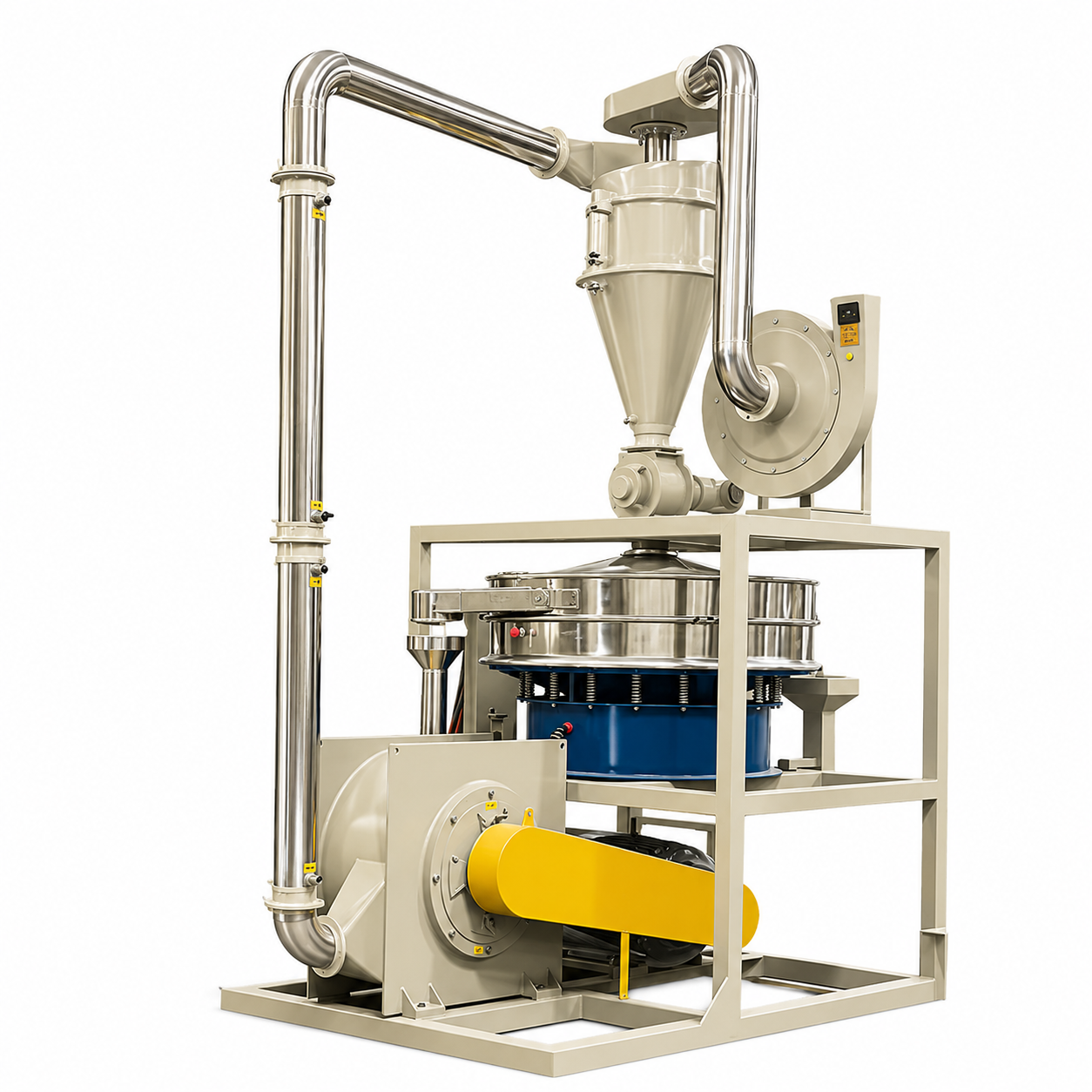
For example, ALVA's Plastic Pulverizer / Plastic Grinding Mill uses combined air and water cooling. This configuration supports temperature control when processing suitable rigid plastic materials.
Grinding does not automatically produce identical particles. Some material reaches the required fineness immediately, while larger fragments need additional processing. Screening and classification systems separate powder according to particle dimensions.
Acceptable material moves toward collection or storage equipment. Oversized fractions may return to the grinding chamber for further reduction. This arrangement helps control the final powder size distribution.
However, excessive recirculation increases equipment loading and can generate additional heat. Operators must balance screening requirements against grinding efficiency and production capacity.
Powder handling becomes more difficult when particle dimensions vary significantly. Very fine particles may create dust or bridging problems, while larger fragments can interrupt consistent feeding. Moisture and electrostatic effects may introduce additional challenges.
Controlled grinding helps manufacturers produce powder suitable for their feeding systems. Consistent material characteristics can improve storage, conveying, and metering performance. However, excessively fine powder does not always flow better.
Manufacturers should consider bulk density, moisture content, and powder flowability alongside particle size.
Different manufacturing processes require different powder properties. PVC extrusion may accept suitably prepared recycled material within a compatible formulation. Rotational molding commonly requires polyethylene powder with controlled particle characteristics.
Plastic pulverizing improves the physical preparation of recycled materials. It cannot remove chemical contamination or reverse polymer degradation caused by previous processing.
Successful reprocessing therefore depends on material sorting, suitable grinding conditions, and downstream quality testing.
Tip: Define the required powder particle size distribution before selecting grinding equipment. Finer powder does not always deliver better processing performance.
Plastic grinding equipment can process several polymer types under suitable operating conditions. However, material hardness, flexibility, and thermal behavior determine the appropriate grinding configuration.
PVC manufacturing generates production offcuts, rejected profiles, and pipe scrap. These materials can often be recovered when their composition remains suitable for reuse. Before grinding, operators typically reduce large pieces into smaller flakes or granules.
A PVC plastic grinding machine converts prepared material into reusable powder. Controlled grinding temperatures are particularly important because PVC is sensitive to excessive heat. Suitable cooling helps limit sticking, discoloration, and unnecessary thermal stress.
ALVA's PVC Grinding Mill / PVC Pulverizer is designed for PVC waste recycling. It uses a high-speed grinding structure and circulating water cooling system.
Polyethylene and polypropylene are widely used in packaging, containers, and industrial products. Their toughness and thermal characteristics create different grinding challenges.
Some PE grades can soften or deform during mechanical grinding. Certain PP materials also require careful temperature and feeding control. Suitable grinding conditions help limit material agglomeration and maintain production stability.
PE powder production is particularly important for rotational molding applications. However, the required grinding method depends on polymer grade and target powder specifications.
Selected engineering plastics, including suitable ABS grades, can enter specialized grinding processes. Their hardness, brittleness, and thermal properties affect the resulting powder characteristics.
Harder materials may increase grinding disc wear, while temperature-sensitive grades require careful cooling. Polymer compatibility must also be considered before recycled material enters new formulations.
Mixing unrelated polymer families can create serious quality problems. Even uniform grinding cannot make incompatible materials behave as a single resin.
Plastic grinding mills usually operate within a broader recycling system. Material preparation, grinding, classification, and powder collection must work together.
Plastic waste often requires sorting, cleaning, and drying before fine grinding. Large objects may first pass through a crusher or granulator. This produces smaller pieces suitable for the grinding chamber.
A controlled feeding system delivers prepared material at a consistent rate. Excessive feeding increases mechanical loading and may generate unnecessary heat. Insufficient feeding can reduce production efficiency.
Uniform incoming material helps maintain consistent grinding conditions and reduces unexpected process fluctuations.
Many plastic pulverizers use rotating and stationary grinding discs. Prepared plastic enters the space between these cutting surfaces. Mechanical shearing and friction progressively reduce material dimensions.
Grinding performance depends on disc geometry, operating speed, and cutting clearance. Smaller clearances generally create finer grinding conditions, but they can also increase heat and wear.
The correct settings depend on polymer behavior and required powder fineness. Operators should avoid using maximum grinding intensity without evaluating material stability.
After grinding, an airflow system may transport powder toward classification equipment. Cyclone collectors separate much of the powder from the conveying air. Additional filters collect fine particles and help control dust emissions.
Screens classify powder according to particle dimensions. Oversized material may return for another grinding cycle. Acceptable powder moves toward storage or downstream processing.
Cooling remains important throughout this operation because material temperature can influence collection and handling.
Manufacturers should evaluate grinding performance according to actual powder quality. Production capacity alone cannot show whether the material suits further manufacturing.
Two powder samples can share similar average particle sizes but behave differently. One may contain excessive fines, while another contains many oversized particles.
These differences affect powder flow, blending, and heating behavior. A narrow and application-appropriate particle size distribution generally supports more predictable processing.
Manufacturers should evaluate representative samples rather than relying only on a nominal mesh rating.
Grinding temperature influences polymer behavior during size reduction. Excessive friction may soften particles or cause them to stick together. Temperature-sensitive materials may also experience discoloration or chemical degradation under unsuitable conditions.
Proper cooling reduces these risks, but temperature requirements vary between polymers. Operators should monitor actual material conditions rather than applying identical limits to every plastic grade.
Feed rate, disc clearance, and cooling capacity must remain balanced during production.
Incoming material quality directly affects grinding results. Moisture, contaminants, and inconsistent particle sizes can change machine behavior. Mixed polymer grades may also produce different powder characteristics during identical grinding conditions.
For example, clean post-industrial PVC scrap usually offers more predictable composition than unsorted mixed plastic waste. However, even clean materials require appropriate processing controls.
Stable feedstock quality improves the chances of achieving consistent recycled powder.
Quality Factor | Common Problem | Effect on Reprocessing | Recommended Control |
|---|---|---|---|
Particle size | Excessive oversized particles | Uneven blending or feeding | Adjust grinding and classification |
Grinding temperature | Material softening | Powder sticking or degradation | Improve cooling and feed control |
Moisture | Damp powder | Agglomeration and inconsistent feeding | Dry material before grinding |
Polymer contamination | Mixed incompatible resins | Unstable final product properties | Improve sorting and identification |
Excessive fines | Dust and poor powder flow | Handling difficulties | Optimize powder classification |
Note: Powder uniformity improves material preparation, but final product quality still depends on resin properties and processing conditions.
Consistent powder characteristics support several industrial manufacturing processes. Each application requires suitable material preparation and specific quality standards.
PVC extrusion manufacturers may reuse suitable production scrap within compatible formulations. Recycled powder can enter material preparation systems for profiles, sheets, and other PVC products.
Consistent particle dimensions help manufacturers control blending and material feeding. Clean recycled material also reduces the risk of visible defects and processing interruptions.
However, recycled content must match product requirements. Manufacturers should verify formulations through extrusion trials before increasing recycled material proportions.
Rotational molding uses polymer powder to form hollow plastic products. During processing, powder distributes inside a heated rotating mold. Its particle size and flow characteristics influence melting and material distribution.
Properly prepared polyethylene powder supports more consistent processing under suitable conditions. Excessive coarse particles may contribute to uneven melting, while too many fines can affect handling.
Grinding requirements should therefore reflect the selected PE grade and rotational molding process.
Some compounding processes use recycled plastic powder as part of their material formulation. Consistent powder preparation helps manufacturers control feeding and ingredient distribution.
Suitable particle dimensions can support mixing performance when polymers and additives are compatible. However, finer grinding does not automatically improve every formulation.
Manufacturers must evaluate recycled material properties, processing temperatures, and the intended final application.
Grinding performance can decline because of unsuitable settings, inconsistent materials, or inadequate maintenance. Identifying these problems early helps protect production quality.
Overheating often results from excessive feeding, unsuitable disc clearances, or inadequate cooling. Heat-sensitive materials may soften and accumulate inside the grinding chamber.
This can reduce powder quality and interrupt material discharge. Operators should inspect cooling performance and review feeding conditions when powder begins sticking.
Reducing unnecessary friction may improve stability without sacrificing the required powder specification.
Worn grinding discs can change cutting behavior over time. Unstable feeding and incorrect classification settings may also increase particle size variation.
Oversized material creates additional processing loads when repeatedly returned for grinding. Excessive recirculation can reduce effective production capacity.
Regular powder sampling helps operators recognize these changes before they affect downstream manufacturing.
Grinding discs gradually wear during continuous operation. Abrasive contamination and unsuitable materials may accelerate cutting surface deterioration.
Powder accumulation can also interfere with equipment cleanliness and ventilation. Plastic dust requires appropriate collection and combustible-dust risk assessment where applicable.
Maintenance should include cutter inspection, cooling checks, and dust collection system monitoring.
Tip: Compare grinding performance using usable powder output, energy consumption, and rejected material. Total throughput alone may hide quality losses.
Reliable plastic grinding requires suitable equipment selection and consistent operating practices. Manufacturers should align machine settings with the intended powder application.
Start by identifying polymer type, initial particle size, toughness, and thermal sensitivity. These properties determine whether conventional grinding can achieve the required powder characteristics.
Disc-type pulverizers are commonly used for suitable rigid plastic granules. More flexible or heat-sensitive materials may require different cutting conditions.
Cryogenic grinding can be useful when cooling makes certain polymers easier to fracture. However, it requires specialized equipment and introduces additional operating costs.
Manufacturers should select cryogenic processing only when material behavior and product requirements justify it.
Grinding disc clearance, rotational speed, and feeding conditions influence powder size. Classification equipment further determines which particles enter the final product.
Finer grinding often increases processing demands and can raise energy consumption. Excessively fine powder may also create handling difficulties.
Manufacturers should balance fineness against throughput and powder quality requirements. The best settings produce acceptable material without unnecessary processing.
Consistent feeding reduces sudden changes in chamber loading. It also helps maintain more predictable grinding conditions.
Cooling equipment should operate within its intended capacity. Operators should monitor relevant temperatures and investigate unusual increases during production.
For larger recycling facilities, integrated equipment planning can simplify material preparation. Manufacturers can review ALVA's industrial recycling and grinding equipment when planning their processing lines.
Regular testing provides practical evidence of grinding performance. Manufacturers should check particle size distribution, moisture, contamination, and powder handling behavior.
Downstream trials are equally important. A powder meeting its nominal size target may still perform poorly during extrusion or molding.
Testing helps manufacturers identify suitable processing conditions before full-scale production.
Tip: Request representative material grinding trials before purchasing equipment. Compare usable powder yield, production stability, and downstream processing results.
A Plastic Grinding Mill supports high-quality plastic reprocessing through consistent particle size, controlled grinding temperatures, and efficient powder classification. It helps manufacturers improve recycled powder quality and maintain stable production.
ALVA Machinery provides plastic pulverizers and PVC grinding mills featuring efficient grinding and cooling systems. Its equipment helps recycling plants process suitable plastic waste into reusable powder. Contact ALVA Machinery for tailored equipment recommendations and quotations.
A: It converts plastic scrap into fine, reusable powder.
A: It produces consistent particles for more stable reprocessing.
A: Controlled grinding supports powder uniformity and material reuse.
A: Pulverizers produce finer powder; crushers reduce larger plastic pieces.
A: Energy use, disc wear, cooling, and production capacity.
A: Adjust feeding, maintain cooling, and monitor grinding temperatures.provides plastic pulverizers and PVC grinding mills featuring efficient grinding and cooling systems. Its equipment helps recycling plants process suitable plastic waste into reusable powder. Contact ALVA Machinery for tailored equipment recommendations and quotations.