Views: 0 Author: Site Editor Publish Time: 2026-08-21 Origin: Site
Transforming scrap plastics into fine powder requires precise mechanical engineering and strict process control. You cannot simply dump large plastic pieces into a pulverizing system and expect high-quality results. Feeding oversized material into the chamber directly impacts throughput, heat generation, and overall equipment lifespan. Establishing the correct input size prevents catastrophic blade wear. It also eliminates thermal degradation of sensitive materials while optimizing energy consumption across your entire size reduction process. Failing to control this initial step often leads to clogged machinery and compromised end products.
This guide addresses ambient and standard grinding conditions to help you achieve the perfect regrind. We outline exact feed requirements carefully. You will learn how to properly configure upstream equipment to meet these strict specifications. Understanding these mechanical realities allows operators to maximize efficiency and produce consistent, high-quality plastic powders.
The standard specification for feeding material into a milling chamber is remarkably strict. Industry standards target a particle size of 6mm to 8mm for most rigid and flexible plastics. The machine relies on this narrow window to apply optimal shear force. Particles matching this size enter the cutting gap smoothly. Larger particles require excessive mechanical energy to break down initially. This extra effort slows the entire operation. It also increases wear on the cutting discs.
Material-specific variations dictate how strictly you must follow these dimensions. Hard or brittle plastics behave differently than soft polymers. Materials like PVC or UPVC can sometimes tolerate slightly larger feed sizes. They might handle pieces up to 10mm without issue. You can achieve this if you process them through a heavy-duty PVC pulverizer. These robust machines handle the extra brittleness efficiently. They shatter the hard plastic upon impact.
Soft or heat-sensitive plastics demand stricter controls. Materials like LDPE and LLDPE melt easily under friction. You must adhere strictly to smaller, uniform feed sizes for these polymers. Keeping the size between 6mm and 8mm minimizes residence time inside the cutting chamber. The plastic exits the machine before it absorbs too much heat. This prevents catastrophic melting and smearing on the cutting discs.
We must define the "regrind" baseline clearly. Acceptable regrind quality goes beyond just average size. Good regrind features consistent geometry. It must lack long, stringy tails or massive chunks. It should also have minimal dust content before entering the micro-grinding stage. Consistent regrind guarantees a stable milling environment.
| Material Type | Optimal Feed Size | Maximum Tolerance | Heat Sensitivity |
|---|---|---|---|
| Rigid PVC / UPVC | 6mm - 8mm | Up to 10mm | Low to Medium |
| HDPE / PP | 6mm - 8mm | 8mm | Medium |
| LDPE / LLDPE | 5mm - 7mm | 7mm | High |
| PET (Flakes) | 6mm - 8mm | 8mm | Medium |
Operational risks multiply quickly when you ignore proper feed sizing. Oversized feed creates an immediate bottleneck risk for the entire plant. Large chunks cause severe mechanical shock to the pulverizer blades and discs. These precision components wear out prematurely under sudden, heavy impacts. The main drive motor experiences violent amperage spikes. The machine struggles constantly to bite and shear the oversized material.
This mechanical struggle leads directly to excessive heat generation. The friction inside the chamber skyrockets. This heat risks severe material degradation. You might see unwanted color changes or burnt specks in the final powder. Heat also decreases overall throughput measured in kilograms per hour. The machine must run slower to prevent complete thermal overload.
Undersized feed presents an entirely different inefficiency risk. Over-processing material in an upstream crusher wastes valuable electrical energy. You spend money creating dust when you only needed 8mm chips. High dust content entering the system complicates everything downstream. The excessive fines disrupt internal airflow dynamics. They also clog airlock valves and filtration systems much faster than normal.
Inconsistent feed geometries result in poor quality outcomes. Uneven feed creates uneven powder. We see this clearly in the final particle size distribution (PSD). A wide PSD heavily affects downstream extrusion or molding processes. The powder will not melt uniformly in an extruder. This causes structural weaknesses in the final molded product.
Upstream equipment plays a mandatory role in your material preparation. A pulverizing machine cannot act as a primary shredder. You must implement a dedicated pre-grinding step. For example, using a high-quality PVC crusher reduces large scrap down to the necessary 6-8mm threshold. The crusher uses heavy rotating knives to chop the plastic. This protects the delicate downstream milling equipment from catastrophic damage.
System integration requires careful physical mapping. You must design a complete plastic recycling line for continuous, automated operation. Manual feeding introduces human error and inconsistent flow rates. A well-designed system connects each machine seamlessly.
The material flow usually follows a strict sequence:
Screen sizing in your upstream equipment dictates your ultimate success. We recommend using specific screen hole sizes on the granulator. Install 8mm to 10mm screens to guarantee the correct output size. The geometry of the screen holes ensures no oversized strips escape into the milling stage. Maintain the granulator blades regularly. Dull blades push material through the screen rather than cutting it clean.
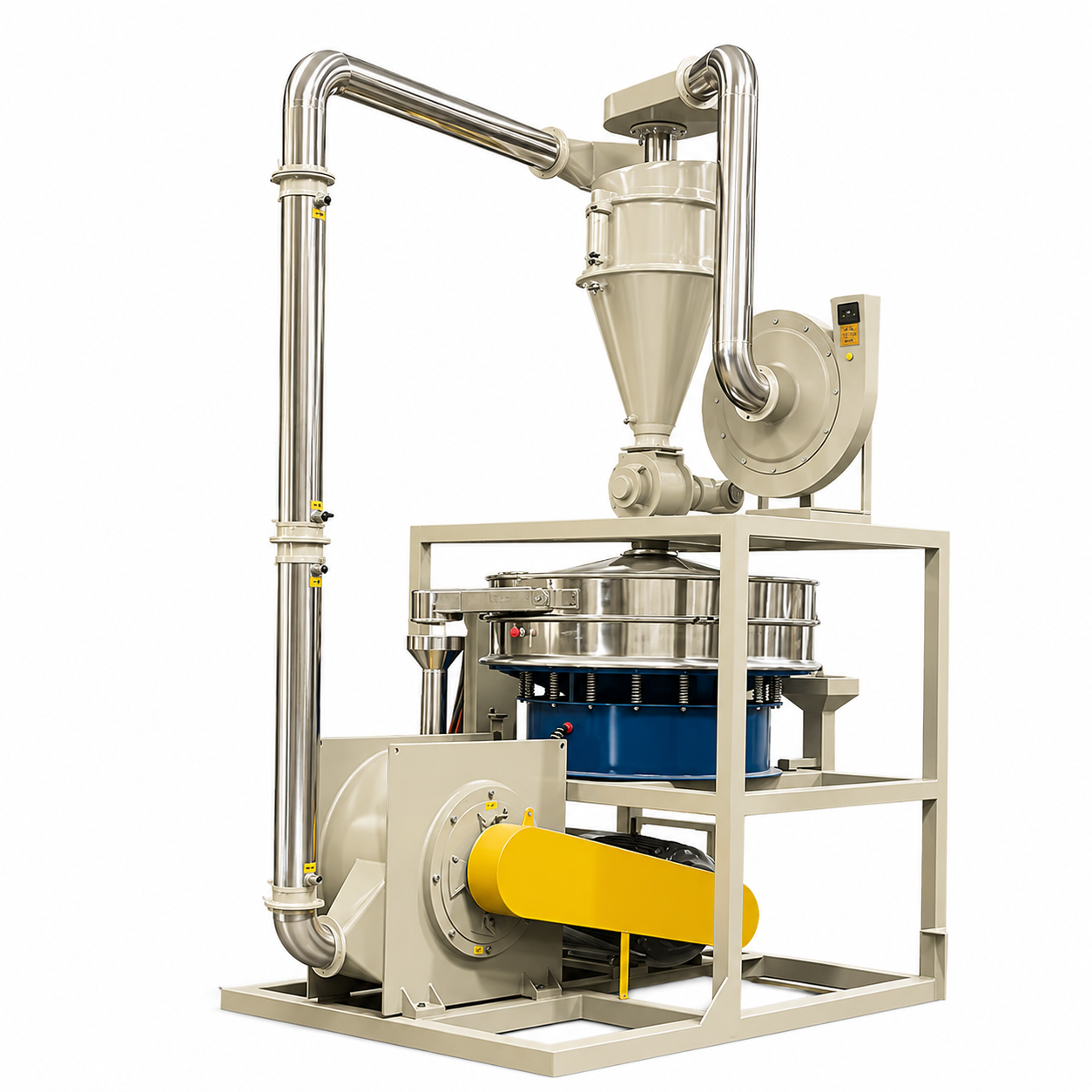
You must evaluate milling equipment based on its specific feed capabilities. Rotor and disc designs vary significantly across manufacturers. Disc-type mills handle rigid materials differently than rotor/stator configurations. Some designs forgive slight geometry variations much better than others. A well-engineered plastic grinding mill manages varying feed hardness while maintaining steady output. Look for systems featuring easily adjustable cutting gaps.
Feeding mechanisms are equally critical to the operation. You need automated, variable-speed dosing systems. Vibratory feeders or rotary valves work exceptionally well. They regulate the exact volume of material entering the mill. This precise control prevents sudden surges inside the cutting chamber. Integrating a reliable plastic pulverizer means utilizing these smart feeding systems. They communicate directly with the main drive motor to adjust feed rates automatically.
Cooling capabilities directly impact material tolerance. Ambient cooling uses water-jacketed chambers. It works well for standard feed sizes and common rigid plastics. Cryogenic cooling injects liquid nitrogen directly into the feed stream. This deep-freezing approach handles slightly larger or tougher feed materials. The extreme cold embrittles the plastic. This makes it shatter instantly upon impact, compensating for slightly oversized feed.
Implementation requires rigorous testing, mechanical tuning, and strict process control. We advise buyers to conduct thorough material audits. Perform a particle size analysis on your current regrind. Do this before specifying any new equipment purchase. You must know your exact starting point. Use a set of testing sieves to measure the exact dimensions of your granulator output. If your regrind shows massive variations, fix your granulator first.
Surge management ensures consistent, profitable operation. You must install buffer silos between the granulator and the pulverizing machine. Silos guarantee a continuous, uniform feed rate. They prevent "starve feeding" which underutilizes the motor and wastes capacity. They also prevent "choke feeding" which jams the cutting chamber and triggers safety shutdowns. A properly sized buffer silo holds enough material to keep the mill running during granulator maintenance.
Blade gap calibration serves as the final mechanical tuning step. The physical gap between the stationary and rotating blades demands extreme precision. You must calibrate this gap in direct relation to your verified feed size. A smaller, highly consistent feed size allows a tighter blade gap. This precise tuning achieves the desired powder mesh accurately. Operators must check this gap frequently using specialized feeler gauges. Heat expansion during operation changes this gap, so measure it under normal running conditions.
Successful pulverization relies entirely on a strict two-step process. You must secure proper sizing upstream before attempting precision milling downstream. You cannot fix bad granulation inside the milling chamber. Buyers should evaluate new machinery based on how smoothly it integrates with their existing granulators.
To improve your current operation, start with a physical audit. Measure your current regrind dimensions using standard mesh sieves. Consult with equipment manufacturers for custom material trials using your specific scrap. Finally, adjust your granulator screens to ensure your entire recycling line remains balanced for continuous, high-quality throughput.
A: No. Whole components must first pass through a shredder and granulator to reach the required 6-8mm feed size.
A: Moisture causes clumping and alters the feeding dynamic, often requiring pre-drying before entering the pulverizer.
A: Cryogenic systems can sometimes handle slightly larger or tougher feeds because the liquid nitrogen embrittles the plastic, but a uniform 6-8mm baseline remains the most efficient starting point.