Views: 0 Author: Site Editor Publish Time: 2026-09-27 Origin: Site
Did you know that unmanaged heat can completely ruin recycled plastic? In the demanding world of polymer processing, friction inevitably melts scrap during the grinding phase. This thermal degradation destroys polymer quality and blocks machinery, leading to costly downtime. However, specialized milling technology solves this exact issue. Throughout this comprehensive guide, we will explore how advanced cooling systems and precise mesh size optimization work together to transform waste into premium-grade, free-flowing powder.
Material Sensitivity: PVC, PE, PP, and ABS each possess distinct thermal thresholds. Applying a uniform grinding approach across all polymers inevitably leads to material degradation and poor powder quality.
Cooling is Crucial: Implementing highly effective water or air cooling systems prevents polymer melting, color degradation, and the frustrating issue of screen clogging.
Mesh Size Dictates Application: The selected mesh size directly influences the fineness, bulk density, and flowability of the powder. These metrics are strictly necessary for downstream manufacturing processes such as extrusion and rotational molding.
System Synergy: Producing optimal powder requires a precise mechanical balance between rotor speed, cooling efficiency, and the vibrating screen mesh size.
Equipment ROI: Capital allocation toward specialized milling equipment reduces material waste, minimizes operational downtime, and significantly increases the market value of the output powder.
The global push for sustainable manufacturing is fundamentally changing how facilities approach plastic recycling. Historically, producing coarse regrind was enough for basic injection molding. Today, stringent circular economy mandates demand higher purity and consistency. Industry analysts note a massive surge in the demand for ultra-fine, highly uniform recycled powders, particularly in the rotomolding and masterbatch sectors. Manufacturers are moving away from generic crushers and investing heavily in specialized milling lines. This shift is driven by the need to seamlessly blend recycled content with virgin polymers without compromising structural integrity or aesthetic finish. Consequently, precision control over particle size and thermal management has transitioned from a competitive advantage to a strict industry requirement.
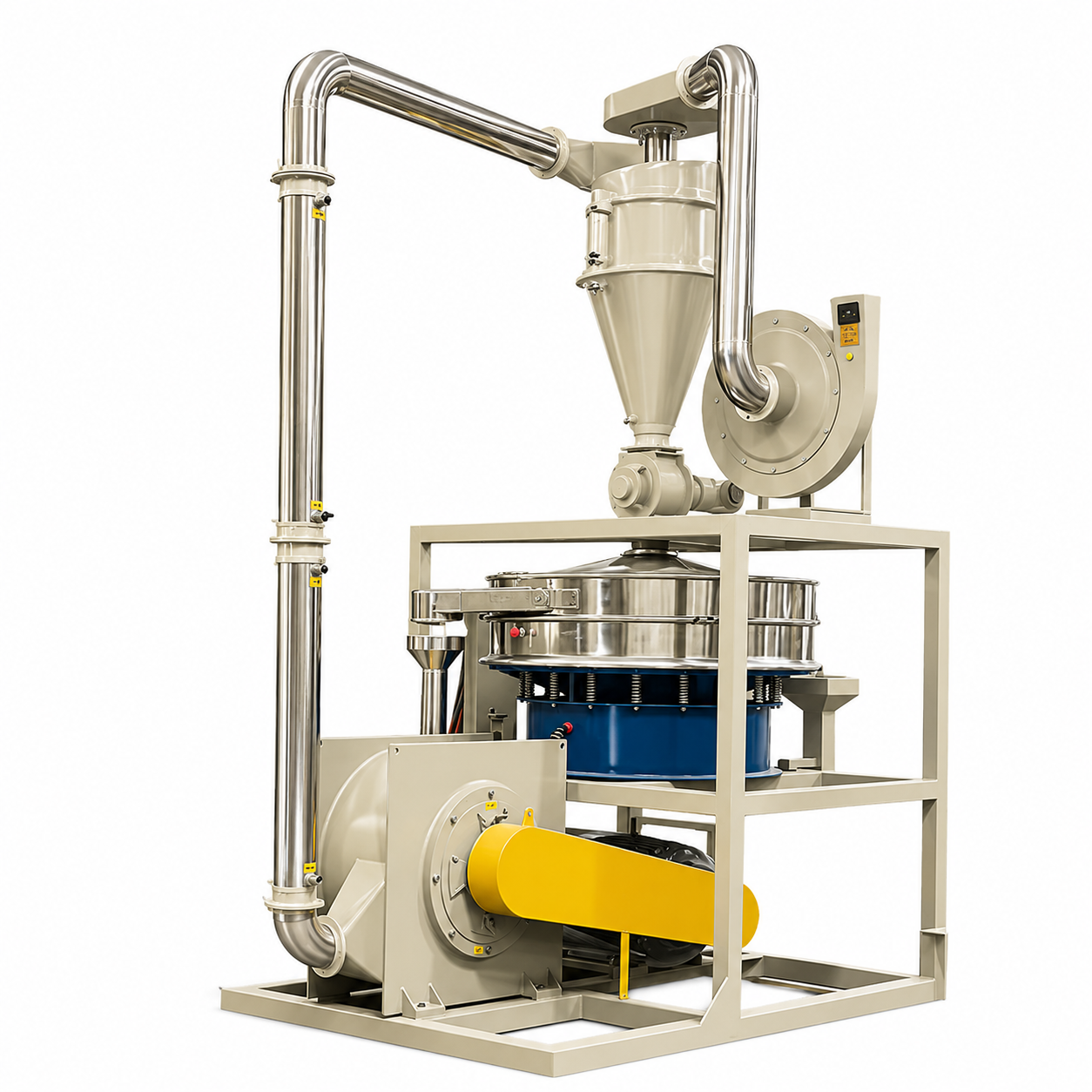
At the core of a modern facility, a plastic recycling mill acts as a high-speed mechanical reduction system. It is engineered to process granules, flakes, or off-cut scraps into a highly refined powder. Unlike standard shredders that merely produce coarse chips, these sophisticated units operate on the principle of high-velocity shearing and impact. Inside the chamber, the main shaft drives specialized rotors at speeds often exceeding 3,000 RPM. This creates massive mechanical shear force, tearing the polymer apart against a stationary stator until the particles are small enough to pass through a designated filtration screen.
For standard injection molding, coarse plastic pellets are generally sufficient. In contrast, advanced manufacturing processes require the raw material to be in a microscopic powder state to function correctly. For instance, rotational molding relies entirely on powder to evenly coat the inside of heated molds. Standard pellets would simply melt into uneven, unusable lumps. Similarly, pipe extrusion and color blending require uniform powder to ensure seamless chemical mixing and consistent melt flow rates.
Understanding the distinct molecular and thermal properties of different polymers is the most critical step in optimizing a grinding operation. Plant managers must adjust their operational parameters based on the specific plastic being processed. Applying the wrong mechanical force to a heat-sensitive polymer is a guaranteed recipe for equipment failure.
Polyvinyl chloride, commonly known as PVC, presents a unique challenge due to its remarkably low thermal stability. When subjected to the high friction of a milling chamber, this material heats up rapidly. If the temperature exceeds its specific threshold, the plastic begins to degrade chemically. This manifests as severe discoloration and the dangerous release of corrosive hydrochloric acid gas. Because of these inherent risks, processing this polymer typically requires a dedicated PVC grinding mill equipped with a specialized disc-type rotor. This specific design provides a clean cutting action that minimizes unnecessary friction. It ensures the material is sheared quickly and exits the chamber before heat accumulation causes a chemical breakdown.
In stark contrast to rigid plastics, flexible polyolefins like polyethylene and polypropylene are characterized by their high melt flow index and relatively low melting points. Instead of burning, they tend to soften and become highly viscous when exposed to friction-induced heat. When these materials reach their softening point inside the chamber, they turn sticky. This adhesive state causes the plastic particles to clump together, leading to bridging in the feed throat or completely clogging the grinding chamber. Processing these flexible plastics demands aggressive temperature control and the utilization of a turbo-type rotor that generates higher internal airflow.
Acrylonitrile butadiene styrene, widely known as ABS, is an engineering plastic renowned for its high impact resistance, rigidity, and hardness. It does not melt as easily as polyethylene, nor does it degrade as rapidly as polyvinyl chloride. However, its sheer toughness requires immense mechanical force to pulverize. The abrasive nature of hard plastics means that the wear and tear on the rotor and stator blades are significantly accelerated. Efficient processing requires equipment built from high-wear-resistant alloys and a motor capable of sustaining high torque without stalling.
Polymer Type | Thermal Sensitivity | Recommended Rotor | Common Mesh Size | Primary Downstream Application |
|---|---|---|---|---|
PVC | High risk of burning | Disc Rotor | 40 - 80 Mesh | Pipe and Profile Extrusion |
PE / LLDPE | High risk of melting | Turbo Rotor | 20 - 35 Mesh | Rotational Molding |
ABS | Moderate | Disc / Pin Rotor | 20 - 40 Mesh | Injection Molding Additives |
The fundamental physics of a grinding chamber dictate that high-speed kinetic energy will inevitably convert into extreme thermal energy. As the rotor spins at thousands of revolutions per minute, the constant shearing and impacting of plastic particles generate significant heat. If this heat is not actively managed, the internal temperature of a plastic powder machine will quickly surpass the thermal limits of the polymer. Imagine a mid-shift shutdown because the rotor is encased in a solid block of melted plastic. This is the harsh reality of poor thermal management. Without adequate cooling, operators experience thermal degradation of the product, severe clumping, and the total loss of the required physical properties.
To combat this friction-induced heat, industrial-grade mills employ sophisticated, multi-layered cooling mechanisms.
Water Cooling Jackets: This is the baseline standard for reliable machinery. The equipment is engineered with integrated water jackets surrounding the main grinding chamber, the bearing housings, and the stationary grinding discs. Chilled water is pumped continuously through these jackets, absorbing the heat from the metal surfaces via conduction.
Induced Air Draft Systems: Working in tandem with water cooling, high-pressure draft fans pull massive volumes of ambient air through the grinding chamber. This draft system acts as a pneumatic conveyor to transport the finished powder out of the mill while continuously flushing the chamber with cooler air to prevent localized heat pockets.
Producing high-quality recycled material is not solely about reducing the size of the plastic. It is about achieving precise dimensional consistency. Modern manufacturing processes require extremely tight particle size tolerances.
In industrial separation, mesh size refers to the number of openings per linear inch of a screen. The higher the mesh number, the finer the particles must be to pass through. When operating fine grinding equipment, the raw plastic flakes are subjected to intense mechanical shear. Once fractured, the material is transported to a vibrating screen. This sieve acts as the primary quality control mechanism. Particles small enough pass through the mesh as the final product. Oversized fragments are automatically rejected and conveyed back into the grinding chamber for further processing.
A fundamental physical trade-off exists in every recycling operation. There is an inverse relationship between powder fineness and production throughput. When a facility requires a very fine powder, such as 60 to 80 mesh, a higher percentage of the material is recirculated back into the milling chamber. This increased residence time means the rotor must perform more mechanical work. Consequently, overall production capacity decreases and specific energy consumption increases. Utilizing a coarser mesh allows material to exit the system rapidly, boosting hourly throughput. However, coarse powder may possess poor bulk density, making it unsuitable for delicate downstream applications.
Achieving the ideal mesh size is mechanically straightforward in theory, but highly dependent on thermodynamic stability in practice. Screen blinding is an industry term describing the phenomenon where semi-melted or tacky plastic particles adhere to the wires of the vibrating mesh screen. Operators often hear a distinct change in the machine acoustic pitch just before blinding occurs. This muffled, laboring sound indicates that material is trapped in a continuous recirculation loop. By utilizing a dual-cooling approach, operators can maintain a stable thermodynamic equilibrium. When the cooling system operates efficiently, the plastic particles remain rigid, dry, and free-flowing, completely eliminating the threat of agglomeration.
Procuring industrial milling equipment represents a significant capital expenditure. For plant managers, evaluating the technical specifications of a plastic pulverizer requires a stringent, evidence-based approach tailored to specific production goals.
The primary mechanical differentiator in milling equipment is the rotor design. Applying the wrong rotor to a specific plastic will result in poor powder quality and accelerated blade wear. Disc pulverizers, featuring flat, serrated discs, are optimal for rigid plastics. They offer precise gap adjustments for consistent shearing. Turbo pulverizers, featuring a turbine-like blade structure, are engineered for flexible, heat-sensitive materials. The turbo design generates massive internal airflow, which is critical for keeping materials cool.
Do not settle for undersized components. For a commercial operation aiming for 150 to 400 kilograms per hour, look for robust specifications. The main motor should range between 37kW and 75kW to provide adequate torque. Ensure the cutting blades are manufactured from high-grade tool steel, such as SKD-11, to withstand the abrasive nature of contaminated scrap. Furthermore, a high-quality machine must feature a fully integrated water-cooling jacket system around both the chamber and the bearing housing to guarantee continuous 24-hour operation.
Modern fine grinding requires precision that manual operation cannot reliably provide. A critical feature to look for is an intelligent vibratory feeder electronically interlocked with the main motor amperage. If the internal load spikes or the temperature approaches the softening point of the polymer, the programmable logic controller must automatically reduce the feed rate. This closed-loop feedback system prevents chamber clogging and protects the motor from catastrophic burnout, ultimately yielding a superior return on investment.
Producing top-tier plastic powder requires a delicate, highly calculated balance of mechanical force, stringent temperature control, and precise particle filtration. Upgrading to a modern, well-cooled milling system not only improves powder flowability but also drastically reduces material waste. By understanding the unique thermal properties of different polymers and matching them with the correct rotor and mesh configurations, facilities can significantly increase their profit margins. Take the time to assess your current grinding capabilities today. To ensure you select the most efficient and robust machinery for your specific material stream, explore the advanced solutions available at cnalva.com and transform your plastic scrap into high-value manufacturing resources.
This polymer is highly heat-sensitive and degrades easily under thermal stress. The grinding chamber temperature should generally be kept strictly below 60 to 70 degrees Celsius. Maintaining this temperature requires a robust water cooling system. Failure to control the heat will result in the discoloration of the powder and the potential release of corrosive gases.
While it is technically possible with a highly versatile machine, it is rarely optimal for industrial-scale production. Rigid plastics typically require a disc-type rotor for effective shearing, whereas flexible polyolefins require a turbo-type rotor for impact grinding and enhanced air cooling. Switching between these materials requires changing the rotor type and replacing the mesh screen, which introduces significant operational downtime.
Clumping, or agglomeration, is almost universally caused by excessive thermal accumulation within the milling chamber. If the cooling infrastructure is inadequate or the feed rate is pushed too high, the internal temperature exceeds the softening point of the plastic. This causes the particles to fuse together, lose their flowability, and eventually blind the vibrating mesh screen.
For rotational molding applications, which predominantly utilize linear low-density polyethylene, a mesh size of 30 to 35 is the industry standard. This specific particle size ensures that the powder possesses excellent bulk density and flowability. It allows the material to melt evenly and coat the interior of the mold smoothly without leaving structural pinholes.
Blade lifespan is highly dependent on the abrasiveness of the specific polymer being processed and the operational throughput. Hard, rigid plastics will dull cutting surfaces much faster than softer polymers. As a general maintenance standard, operators should physically inspect the blades or discs every 300 to 500 hours of operation to ensure consistent shearing efficiency and prevent drops in production capacity.
Power consumption varies based on the required throughput and powder fineness. A standard industrial unit producing 200 to 300 kilograms per hour typically utilizes a main motor between 37kW and 55kW. When factoring in auxiliary equipment like draft fans and rotary valves, the total system power usually ranges from 45kW to 75kW. Efficient machines use automated feed controls to keep the motor running at optimal amperage, preventing energy waste.
Preventing material adhesion relies entirely on maintaining a low internal temperature. Operators must ensure the water-cooling jackets have adequate flow and that the chilled water supply remains below 15 degrees Celsius. Additionally, adjusting the induced draft fan to pull more air through the chamber helps pneumatic conveying and removes residual heat, keeping the plastic particles dry and preventing them from sticking to the metal surfaces.